Handwritten Thread Pool
Thread Pool
The code below uses the single-queue
BlockingQueue. When using the double-queue version, replace allBlockingQueuewithBlockingQueuePro.
Interface
Constructor: Initializes the blocking queue with a unique_ptr, creates threads_num threads, and binds each to the Worker function. (All Workers block inside Pop() at this point.)
Post: Submits a task to the thread pool.
Destructor: Wakes up all consumer threads. Workers that find no tasks exit. This has nothing to do with producers.
#pragma once

#include <thread>
#include <functional>
#include <vector>

template <typename T>
class BlockingQueue;

class ThreadPool {
public:
    // initialize the thread pool
    explicit ThreadPool(int threads_num);

    // stop the thread pool
    ~ThreadPool();

    // submit a task to the thread pool
    void Post(std::function<void()> task);

private:
    // the loop function each thread runs
    void Worker();
    // task queue
    std::unique_ptr<BlockingQueue<std::function<void()>>> task_queue_;
    // holds all thread objects; each thread is bound to Worker()
    std::vector<std::thread> workers_;
};
#include "blockingqueue.h"
#include <memory>
#include "threadpool.h"
// Creates a blocking queue and spawns threads_num threads, each bound to Worker().
ThreadPool::ThreadPool(int threads_num) {
task_queue_ = std::make_unique<BlockingQueue<std::function<void()>>>();
for (size_t i = 0; i < threads_num; ++i) {
workers_.emplace_back([this] {Worker();});
// The lambda [this] { Worker(); } captures this, so each thread can call the current object's Worker.
}
}
// Stop the thread pool
// Cancel the queue and wake up all blocked threads
ThreadPool::~ThreadPool() {
task_queue_->Cancel();
for(auto &worker : workers_) {
if (worker.joinable())
worker.join();
}
}
// Submit a task
void ThreadPool::Post(std::function<void()> task) {
task_queue_->Push(task);
}
// Fetch a task from task_queue_ and execute it
void ThreadPool::Worker() {
while (true) {
std::function<void()> task;
// blocking is implemented inside Pop
if (!task_queue_->Pop(task)) {
break;
}
task();
}
}Blocking Queue (Single-Queue Version)
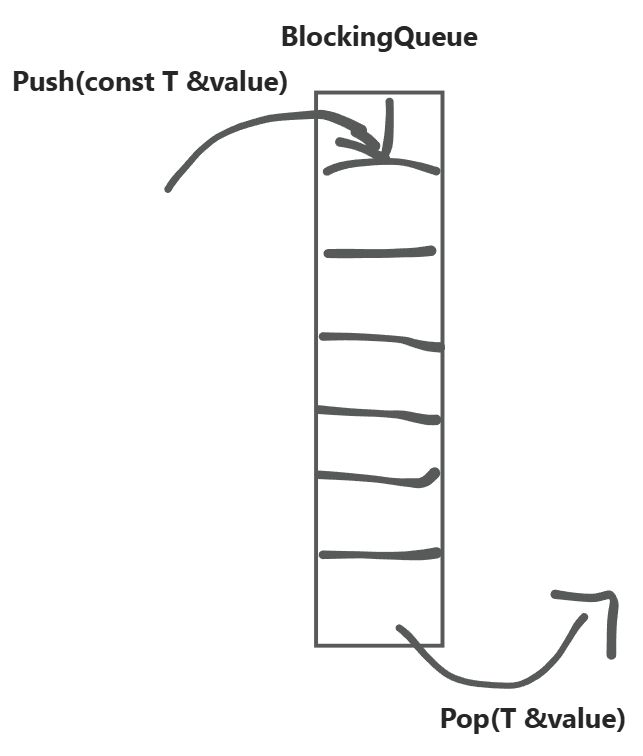
Single-queue maintenance:
nonblock_(bool): non-blocking flag. Whentrue, the queue does not block. Default is blocking (false) at construction.queue_(std::queue<T>): the underlying storage container.mutex_(std::mutex): mutex for thread-safe access.not_empty_(std::condition_variable): used for producer-consumer synchronization.
template <typename T>
class BlockingQueue {
public:
    BlockingQueue(bool nonblock = false) : nonblock_(nonblock) { }
    // enqueue
    void Push(const T &value) {
        // lock_guard automatically locks/unlocks (locks on construction, unlocks on destruction)
        std::lock_guard<std::mutex> lock(mutex_);
        // push element into queue
        queue_.push(value);
        // notify one waiting thread: the queue is not empty, a task is available
        not_empty_.notify_one();
    }
    // normal pop: element is returned
    // exceptional pop: no element returned
    bool Pop(T &value) {
        // lock — if already locked by another thread, this thread blocks here
        // condition_variable::wait requires unique_lock
        std::unique_lock<std::mutex> lock(mutex_);

        // The main purpose of this line is to ensure safe dequeue.
        // We only proceed when the queue is non-empty.
        // But what if we only check queue emptiness and Cancel() is called?
        // After Cancel(), we want consumers to exit, but they'd still block here
        // because they don't know whether to stop.
        // So we use nonblock_ to signal consumers to stop.
        //
        // Proceed when: queue is non-empty OR Cancel() has been called
        //   -> predicate is true -> continue
        // Block when: queue is empty AND Cancel() has NOT been called
        //   -> predicate is false -> auto-unlock mutex, yield CPU, block here
        not_empty_.wait(lock, [this]{ return !queue_.empty() || nonblock_; });
        if (queue_.empty()) return false;  // consumer thread exits

        value = queue_.front();
        queue_.pop();
        return true;
    }

    // unblock all threads waiting on this queue
    void Cancel() {
        // auto lock/unlock
        std::lock_guard<std::mutex> lock(mutex_);
        // tell consumers to stop
        nonblock_ = true;
        // wake up all threads blocked in wait (each woken thread re-evaluates the predicate)
        not_empty_.notify_all();
    }

private:
    bool nonblock_;
    std::queue<T> queue_;
    std::mutex mutex_;
    std::condition_variable not_empty_;
};
Blocking Queue (Double-Queue Version)
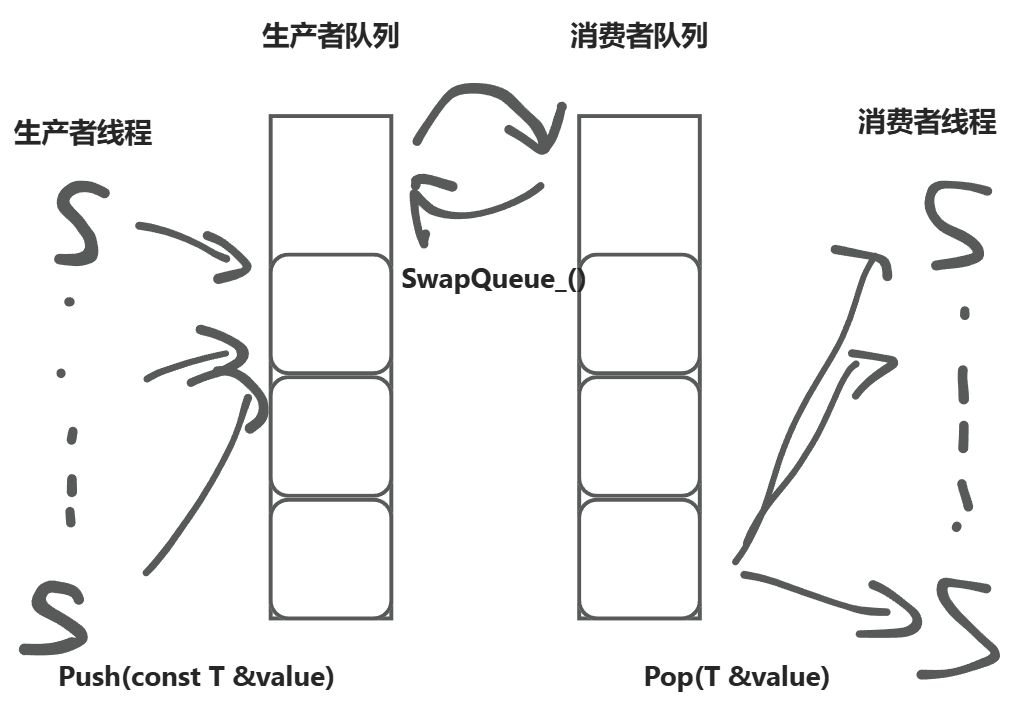
In the single-queue version, both producers and consumers compete for the same lock.
Double-queue design:
prod_queue_: the queue producers write to (protected byprod_mutex_).cons_queue_: the queue consumers read from (protected bycons_mutex_).- When the consumer queue is empty,
SwapQueue_()swaps the two queues, enabling batch transfer.
Benefits:
- Reduced lock contention: producers and consumers mostly do not compete for the same lock.
- Higher throughput: a single swap lets consumers retrieve data in bulk, reducing frequent locking.
template <typename T>
class BlockingQueuePro {
public:
    BlockingQueuePro(bool nonblock = false) : nonblock_(nonblock) {}

    void Push(const T &value) {
        std::lock_guard<std::mutex> lock(prod_mutex_);
        prod_queue_.push(value);
        not_empty_.notify_one();
    }

    bool Pop(T &value) {
        std::unique_lock<std::mutex> lock(cons_mutex_);
        // auto-trigger swap when consumer queue is empty; if still empty after swap, return false
        // no need for .wait here
        if (cons_queue_.empty() && SwapQueue_() == 0) {
            return false;
        }
        value = cons_queue_.front();
        cons_queue_.pop();
        return true;
    }

    void Cancel() {
        std::lock_guard<std::mutex> lock(prod_mutex_);
        nonblock_ = true;
        not_empty_.notify_all();
    }

private:
    int SwapQueue_() {
        std::unique_lock<std::mutex> lock(prod_mutex_);
        // block when producer queue is empty and not cancelled
        // proceed when cancelled regardless of queue state
        not_empty_.wait(lock, [this] {return !prod_queue_.empty() || nonblock_; });
        std::swap(prod_queue_, cons_queue_);
        // return the number of items now in the consumer queue
        // =0 only when producer queue was empty and cancellation was signalled
        return cons_queue_.size();
    }

    bool nonblock_;
    std::queue<T> prod_queue_;
    std::queue<T> cons_queue_;
    std::mutex prod_mutex_;
    std::mutex cons_mutex_;
    std::condition_variable not_empty_;
};
Benchmark
The double-queue version is theoretically faster due to reduced lock contention. The experiment below confirms this.
Setup: 4 producer threads, each submitting 25,000 tasks (each task runs a 1,000-iteration loop). The consumer thread count equals the optimal thread count for the current CPU (std::thread::hardware_concurrency()). In this WSL environment, that is 16.
Both single (single-queue) and double (double-queue) versions are benchmarked, outputting total elapsed time and QPS.
std::atomic<int> task_counter{0};
int main() {
    const int num_producers = 4;
    const int num_tasks_per_producer = 25000; // 100,000 tasks total
    const int num_threads_in_pool = std::thread::hardware_concurrency();

    // For testing, the single and double versions are subclasses of ThreadPoolBase
    // See appendix for implementation details
    ThreadPoolSingle pool(num_threads_in_pool);

    auto start = std::chrono::high_resolution_clock::now();

    std::vector<std::thread> producers;
    // 4 producers start working
    for (int i = 0; i < num_producers; ++i) {
        producers.emplace_back(Producer, std::ref(pool), i, num_tasks_per_producer);
    }
    for (auto& p : producers) {
        p.join();
    }

    // main thread busy-waits; using std::condition_variable to wait for wakeup would be more efficient
    while (task_counter < num_producers * num_tasks_per_producer) {
        std::this_thread::sleep_for(std::chrono::milliseconds(50));
    }

    auto end = std::chrono::high_resolution_clock::now();
    double elapsed = std::chrono::duration<double>(end - start).count();

    int total_tasks = num_producers * num_tasks_per_producer;
    std::cout << "[Single Queue] Total: " << total_tasks
              << " tasks. Time: " << elapsed
              << " seconds. QPS = " << total_tasks / elapsed << std::endl;
}
void Task(int id) {
volatile long sum = 0;
for (int i = 0; i < 1000; ++i) {
sum += i;
}
task_counter++;
}
void Producer(ThreadPoolSingle& pool, int producer_id, int num_tasks) {
for (int i = 0; i < num_tasks; ++i) {
int task_id = producer_id * 100000 + i;
pool.Post([task_id]() { Task(task_id); });
}
}Results:

After reducing task count and main-thread poll interval by 10x (tasks per producer: 2,500, poll interval: 5 ms) — the original completed too fast and the main thread wait time distorted results:

Averaging across runs would be more rigorous, but the gap is large enough that measurement error does not affect the conclusion.
Appendix
Modified single-queue and double-queue versions
#pragma once

#include <thread>
#include <functional>
#include <vector>
#include "blockingqueue.h"
#include "blockingqueuepro.h"

// forward declarations
// blockingqueue can only be used as pointer or reference

// template <typename T>
// class BlockingQueue;
// template <typename T>
// class BlockingQueuePro;

// class ThreadPool {
// public:
//     // initialize the thread pool
//     explicit ThreadPool(int threads_num);

//     // stop the thread pool
//     ~ThreadPool();

//     // submit a task to the thread pool
//     void Post(std::function<void()> task);

// private:
//     void Worker();
//     std::unique_ptr<BlockingQueue<std::function<void()>>> task_queue_;
//     std::vector<std::thread> workers_;
// };


class ThreadPoolBase {
public:
    explicit ThreadPoolBase(int threads_num) : threads_num_(threads_num) {}
    virtual ~ThreadPoolBase() = default;

    virtual void Post(std::function<void()> task) = 0;

protected:
    int threads_num_;
    std::vector<std::thread> workers_;
};

class ThreadPoolSingle : public ThreadPoolBase {
public:
    explicit ThreadPoolSingle(int threads_num)
        : ThreadPoolBase(threads_num),
          task_queue_(std::make_unique<BlockingQueue<std::function<void()>>>()) {
        for (int i = 0; i < threads_num_; ++i) {
            workers_.emplace_back([this] { Worker(); });
        }
    }

    ~ThreadPoolSingle() {
        task_queue_->Cancel();
        for (auto &w : workers_) {
            if (w.joinable()) w.join();
        }
    }

    void Post(std::function<void()> task) override {
        task_queue_->Push(task);
    }

private:
    void Worker() {
        while (true) {
            std::function<void()> task;
            if (!task_queue_->Pop(task)) break;
            task();
        }
    }

    std::unique_ptr<BlockingQueue<std::function<void()>>> task_queue_;
};

class ThreadPoolDouble : public ThreadPoolBase {
public:
    explicit ThreadPoolDouble(int threads_num)
        : ThreadPoolBase(threads_num),
          task_queue_(std::make_unique<BlockingQueuePro<std::function<void()>>>()) {
        for (int i = 0; i < threads_num_; ++i) {
            workers_.emplace_back([this] { Worker(); });
        }
    }

    ~ThreadPoolDouble() {
        task_queue_->Cancel();
        for (auto &w : workers_) {
            if (w.joinable()) w.join();
        }
    }

    void Post(std::function<void()> task) override {
        task_queue_->Push(task);
    }

private:
    void Worker() {
        while (true) {
            std::function<void()> task;
            if (!task_queue_->Pop(task)) break;
            task();
        }
    }

    std::unique_ptr<BlockingQueuePro<std::function<void()>>> task_queue_;
};
贡献者


最近更新
Involution Hell© 2026 byCommunityunderCC BY-NC-SA 4.0


